Back to all work

01 / Case study

BMW Flash Platform

I gave the team control of its firmware tests, from launch to the next morning’s results.

Role
Platform engineering, product design and delivery
Status
Professional work
Platform
Web / Cloud / Physical systems
Year
2025 / 2026
Tools
Python / Next.js / PostgreSQL / AWS / Bazel
BMW Flash Platform, I gave the team control of its firmware tests, from launch to the next morning’s results.
BMW Flash PlatformPlatform engineering, product design and delivery

Overview

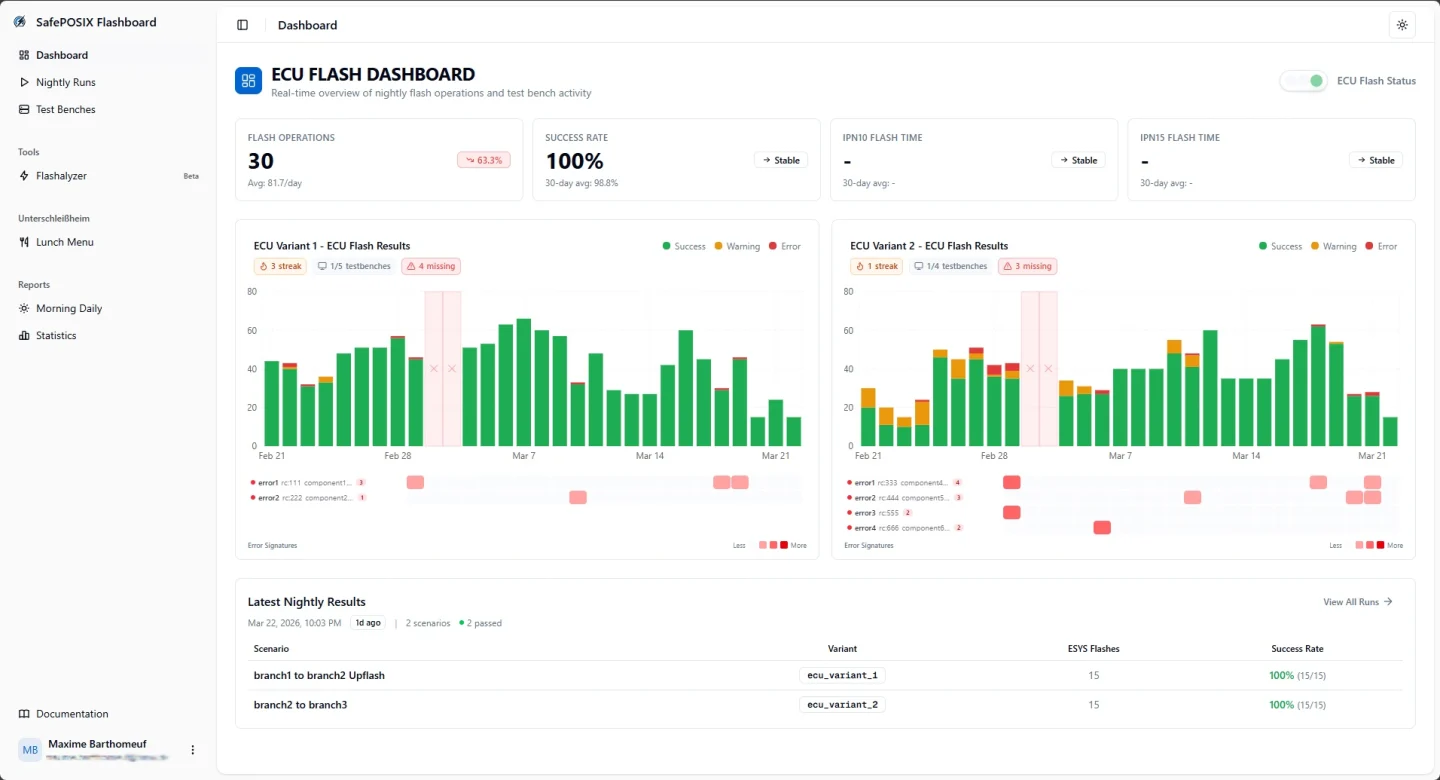
BMW already ran automated tests across the organisation. The team needed a complementary system it could control with its own scenarios and firmware versions. I extended the runner, designed the nightly orchestrator and built Flashboard so the whole flow could be prepared, launched and understood in a browser.

~50daily users
100–150flash operations nightly
~20physical test benches
~8kexecutions recorded by June 2026

Inside the project

What I chose to make simpler

A readable reference, followed by confirmation

Instead of finding, downloading, extracting and placing firmware files by hand, the user enters a readable reference. Flashboard resolves it, then shows the exact version before execution. The flow is shorter without taking control away.

Use the benches at night, but only when they are ready

The hardware was shared by teams during the day. At night, the orchestrator checks reservations and health, attempts recovery, then leaves a bench out when continuing would waste more tests.

Give the morning investigation a starting point

The repetition matrix groups recurring error signatures. It does not diagnose the cause on its own, but it helps the team decide what to examine first.
“I could give him a loosely defined problem and count on him to come back with something well thought through, usually faster than I expected.”

Lewon Simonian · Technical Area Lead, BMW Group

Next project

Redline Coach